
How to Calculate Percentage – Easy Formula, Examples & Step-by-Step Guide
Percentages are part of everyday life. Whether you’re calculating exam results, discounts while shopping, tax amounts, profit margins, or interest rates, knowing how to calculate percentage is an essential skill.
Many people think percentage calculations are complicated, but the truth is they are quite simple once you understand the formula. In this complete guide, you’ll learn:
- What percentage means
- Basic percentage formula
- Step-by-step examples
- Different types of percentage calculations
- Common mistakes to avoid
- Real-life applications
Everything is explained in simple language so anyone can understand it easily.
What Does Percentage Mean?
The word “percent” means per hundred.
So, when we say 20%, it literally means:
👉 20 out of 100
For example:
- 50% means 50 out of 100
- 10% means 10 out of 100
- 75% means 75 out of 100
Percentages help compare values in a clear and standardized way.
Basic Percentage Formula
The most important formula is:
👉 Percentage = (Part ÷ Whole) × 100
Where:
- Part = the value you want to compare
- Whole = the total value
Multiply the result by 100 to express the decimal value as a percentage.
Example 1: Finding Percentage of Marks
Suppose you scored 45 marks out of 60.
Step 1: Divide part by whole
45 ÷ 60 = 0.75
Step 2: Multiply by 100
0.75 × 100 = 75%
👉 Your percentage is 75%.
Example 2: Calculating Discount Percentage
A shirt costs $100 and you get $20 off.
Step 1: Divide discount by original price
20 ÷ 100 = 0.20
Step 2: Multiply by 100
0.20 × 100 = 20%
👉 The discount is 20%.
Example 3: Finding 25% of a Number
If you want to calculate 25% of 200:
Step 1: Convert percentage to decimal
25% = 0.25
Step 2: Multiply
0.25 × 200 = 50
👉 25% of 200 is 50.
If you prefer quick calculations without manual math, you can explore helpful online calculation tools here:
These tools make percentage calculations faster and easier.
Different Types of Percentage Calculations
There are several common types.
1. Finding the Percentage of a Number
Formula:
👉 (Percentage ÷ 100) × Number
Example:
15% of 80
15 ÷ 100 = 0.15
0.15 × 80 = 12
Answer: 12
2. Finding What Percentage One Number Is of Another
Formula:
👉 (Part ÷ Whole) × 100
Example:
30 is what percent of 150?
30 ÷ 150 = 0.2
0.2 × 100 = 20%
3. Percentage Increase
Formula:
👉 [(New Value – Original Value) ÷ Original Value] × 100
Example:
Price increases from $50 to $60.
60 – 50 = 10
10 ÷ 50 = 0.2
0.2 × 100 = 20%
4. Percentage Decrease
Formula:
👉 [(Original Value – New Value) ÷ Original Value] × 100
Example:
Price drops from $80 to $60.
80 – 60 = 20
20 ÷ 80 = 0.25
0.25 × 100 = 25%
Real-Life Applications of Percentage
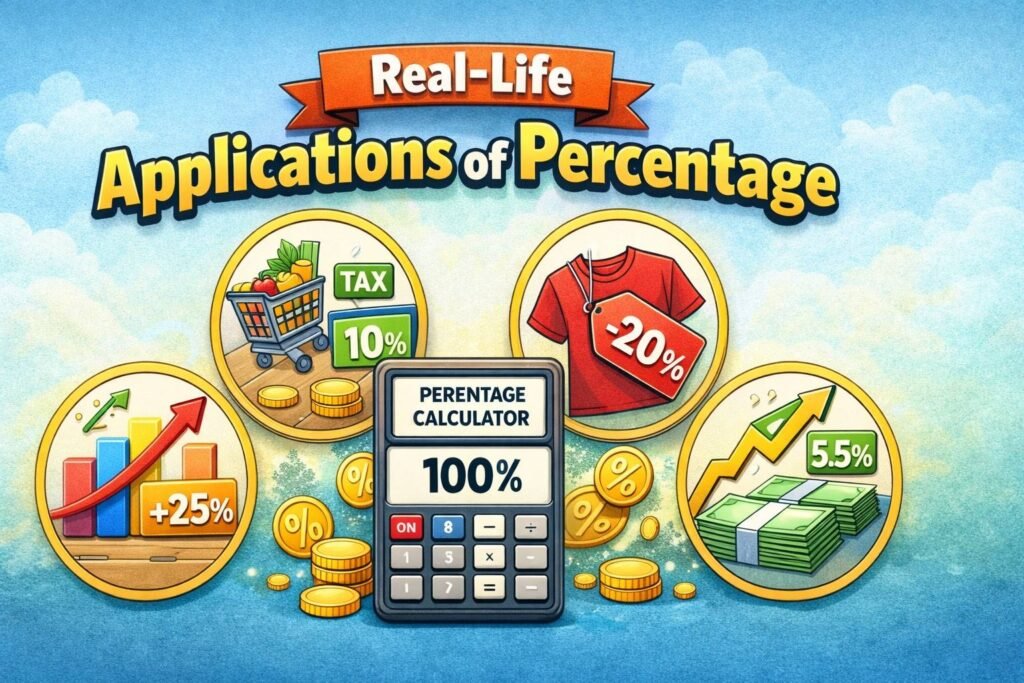
Percentages are used everywhere.
Shopping
Calculating discounts and sales tax.
Banking
Interest rates and loan calculations.
Exams
Calculating grades and performance.
Business
Profit margins and revenue growth.
Health & Fitness
Weight loss percentages.
For deeper math understanding, educational resources like
Khan Academy’s percentage lessons explain percentage concepts clearly.
Common Mistakes to Avoid
Here are frequent errors:
❌ Forgetting to Multiply by 100
Always multiply by 100 when converting to percentage.
❌ Mixing Up Part and Whole
Ensure correct placement in formula.
❌ Calculation Errors
Double-check division and multiplication.
❌ Confusing Percentage with Decimal
Remember:
25% = 0.25
Avoiding these mistakes improves accuracy.
Quick Percentage Tips
Here are some mental math tricks:
- 10% of a number = divide by 10
- 50% = half
- 25% = divide by 4
- 1% = divide by 100
These shortcuts save time.
Why Learning Percentage Is Important
Understanding percentages helps you:
- Make smarter financial decisions
- Compare values easily
- Improve academic performance
- Avoid calculation mistakes
- Understand statistics better
It’s a basic math skill that benefits everyone.
FAQ – How to Calculate Percentage
What is the easiest way to calculate percentage?
Use the formula: (Part ÷ Whole) × 100.
How can I find 20% of a number?
Multiply the number by 0.20.
How do I calculate percentage increase?
(New – Original) ÷ Original × 100.
Why do we multiply by 100?
Because percentage means “per hundred.”
Can I calculate percentage without a calculator?
Yes, using basic division and multiplication.
Where are percentages used in real life?
Shopping, banking, exams, business, and daily decisions.
Final Thoughts
Learning how to calculate percentage is one of the most useful math skills you can have. From school exams to financial planning, percentages help you understand numbers clearly and make informed decisions.
By mastering the basic formula and practicing real examples, you can calculate percentages quickly and confidently.
👉 If you want fast and easy percentage calculations, explore online tools at Calculate Percentage.
Small math skills often make a big difference in everyday life.